Each double page will contain a painting/drawing/sketch of the flower/plant, a pressed example, a photograph(Polaroid?), a short description from the Spring Flowers Guidebook, medical uses, the full Latin name, and urban myths.
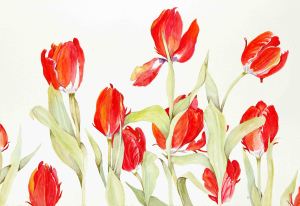
1. Tulip Tulipa Gesnerana (Group: Bulbous perennial) will flower usually between March and May. Tulips grow best in fertile, well-drained soil in full sun, sheltered from strong winds. All dislike excessively wet conditions. The flowers are social, they are usually found in large clusters, and can come in a variety of colours, from pale yellows, to purples, and reds.
Due to the high price of the plant, not much research has been conducted into the medicinal value of tulips. In ancient herbal medicinal books, only few references can be found regarding the medicinal uses of the plant, as not many would want to crush the petals of the precious flower. During the WWII, the Dutch overcame the scarcity of food by eating the bulbs of Tulips which is healthy and nutritious food. In Afghanistan, tulip is eaten for gaining strength. In Britain the Tuna, stuffed tulips recipe, is a classic dish of special occasion.
Tulip flowers are known to be an excellent poultice for insect bites, bee stings, burns, and rashes on the skin, as it gave quick relief with a soothing effect
Tulips
BY SYLVIA PLATH
The tulips are too excitable, it is winter here.
Look how white everything is, how quiet, how snowed-in.
I am learning peacefulness, lying by myself quietly
As the light lies on these white walls, this bed, these hands.
I am nobody; I have nothing to do with explosions.
I have given my name and my day-clothes up to the nurses
And my history to the anesthetist and my body to surgeons.
They have propped my head between the pillow and the sheet-cuff
Like an eye between two white lids that will not shut.
Stupid pupil, it has to take everything in.
The nurses pass and pass, they are no trouble,
They pass the way gulls pass inland in their white caps,
Doing things with their hands, one just the same as another,
So it is impossible to tell how many there are.
My body is a pebble to them, they tend it as water
Tends to the pebbles it must run over, smoothing them gently.
They bring me numbness in their bright needles, they bring me sleep.
Now I have lost myself I am sick of baggage——
My patent leather overnight case like a black pillbox,
My husband and child smiling out of the family photo;
Their smiles catch onto my skin, little smiling hooks.
I have let things slip, a thirty-year-old cargo boat
stubbornly hanging on to my name and address.
They have swabbed me clear of my loving associations.
Scared and bare on the green plastic-pillowed trolley
I watched my teaset, my bureaus of linen, my books
Sink out of sight, and the water went over my head.
I am a nun now, I have never been so pure.
I didn’t want any flowers, I only wanted
To lie with my hands turned up and be utterly empty.
How free it is, you have no idea how free——
The peacefulness is so big it dazes you,
And it asks nothing, a name tag, a few trinkets.
It is what the dead close on, finally; I imagine them
Shutting their mouths on it, like a Communion tablet.
The tulips are too red in the first place, they hurt me.
Even through the gift paper I could hear them breathe
Lightly, through their white swaddlings, like an awful baby.
Their redness talks to my wound, it corresponds.
They are subtle : they seem to float, though they weigh me down,
Upsetting me with their sudden tongues and their color,
A dozen red lead sinkers round my neck.
Nobody watched me before, now I am watched.
The tulips turn to me, and the window behind me
Where once a day the light slowly widens and slowly thins,
And I see myself, flat, ridiculous, a cut-paper shadow
Between the eye of the sun and the eyes of the tulips,
And I have no face, I have wanted to efface myself.
The vivid tulips eat my oxygen.
Before they came the air was calm enough,
Coming and going, breath by breath, without any fuss.
Then the tulips filled it up like a loud noise.
Now the air snags and eddies round them the way a river
Snags and eddies round a sunken rust-red engine.
They concentrate my attention, that was happy
Playing and resting without committing itself.
The walls, also, seem to be warming themselves.
The tulips should be behind bars like dangerous animals;
They are opening like the mouth of some great African cat,
And I am aware of my heart: it opens and closes
Its bowl of red blooms out of sheer love of me.
The water I taste is warm and salt, like the sea,
And comes from a country as far away as health
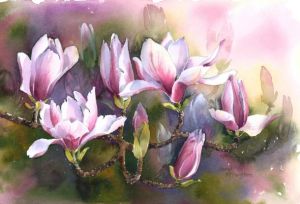
2, Magnolia Magnolioideae Grandiflora, Magnoliaceae grow in full sun. Magnolias thrive in any fertile, moist soil. Magnolia flowers in flushes from spring until early autumn. In warm summers these can be followed by striking knobbly seedpods from which bright red seeds emerge in autumn. Magnolias are trees or shrubs with astonishing goblet or star-shaped flowers that are admired icons of spring and summer.
Magnolia bark (Magnolia officinalis) is a traditional Chinese medicine used since 100 A.D. to support the body and nurture wellbeing and to treat a plethora of ailments.
Magnolia bark has been used to treat menstrual cramps, abdominal pain, abdominal bloating and gas, nausea, and indigestion. The bark is also an ingredient in formulas used for treating coughs and asthma. The bark is used internally in the treatment of abdominal distension, loss of appetite, gastro-enteritis, vomiting, diarrhoea, asthma and coughs with acute phlegm. The bark and flower buds of Magnolia officinalis have been used to treat coughs and colds and intestinal problems.
Japanese researchers have determined that “honokiol” and “magnolol”, two chemicals found in Magnolia Bark, are up to 1000 times more potent than Vitamin E in antioxidant activity. These two active compounds are thought to contribute to the primary anti-stress and cortisol-balancing effects of the plant. Numerous animal studies have demonstrated honokiol to act as an anti-stress agent at lower doses. Magnolol, a compound isolated from the cortex of Magnolia officinalis, has been found to possess anti-allergic and anti-asthmatic activity.
An extract from a Shirley Hughes poem (full poem can be found on page 1):
Sunshine at Bedtime
Trees full of “candles”
Alight in the park,
Sunshine at bedtime,
Why isn’t it dark?
The magnolia buds of pale creams and pinks are the “candles” Hughes talks of in this poem, written about the transition from winter to spring, and the flowers that come with this change.
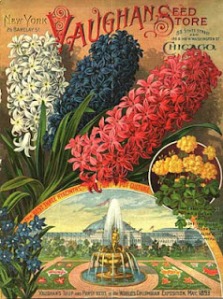
3.Hyacinths Hyacinthus, Asparagaceae, Scilloideae is a small genus of bulbous flowering plants, that bloom between March and April. These intricate flowers prefer well-drained, fertile soil, in full sun. Gloves should be used when handling the bulbs to prevent skin allergies and ingestion should be avoided at all costs. Hyacinths are most commonly found with a pastel palette of pale purples, lilacs, pinks, and creams.
In the past it was widely believed that these particular flowers revived the soul and filled it with joy.
“In the language of flowers, one of the meanings of the hyacinth is “a constant source of joy.”” – Unknown
If of thy mortal goods thou art bereft
And from thy slender store
Two loaves alone to thee are left,
Sell one, and with the dole,
Buy hyacinths to feed thy soul.
~ Saadi, Persian poet
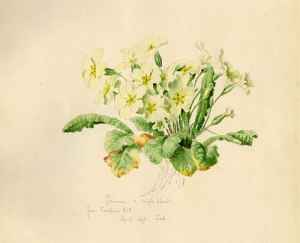
4.Primrose Primula Vulgaris is a flowering plant in the family Primulaceae. Other common species in this family include the familiar wildflowers of banks and verges, Auricula, Cowslip and Oxlip. Primroses are herbaceous or semi-evergreen perennials, forming a base rosette of simple leaves, with salver-shaped or bell-shaped flowers which may be solitary or carried in whorls on an erect stem. The most common colour for a Primrose is pale “primrose” yellow, however, they can be seen in rich purples, reds, pinks, and oranges. This plant is abundant in woods, hedgerows, pastures and on railway embankments throughout Great Britain, and is in full flower during April and May. In sheltered spots in mild winters it is often found in blossom during the opening days of the year.
In the early days of medicine, the Primrose was considered an important remedy in muscular rheumatism, paralysis and gout. The whole plant is a sedative and in modern days a tincture of the fresh plant in bloom has been used with success for extreme sensitiveness, restlessness and insomnia. An infusion of the flowers was formerly considered excellent against nervous hysterical disorders.
My Primrose by Joseph Horatio Chant
My sweet primrose with thy open face,
And with fringe-like leaves, without a trace
Of coarseness, either in flower or stem,
Among all my plants thou art the gem.
My lovely lilies soon disappear;
Thy bloom is constant through all the year;
In summer’s heat and winter’s cold,
Undimmed the light of thy floral gold.
Or if thy color be pink, or blue,
Or white as snow, thou art ever true;
My room is bright with thy smiling eyes,
And thy fragrance rare I also prize.
Thou hast done thy part, my little pet–
Let me keep thy roots forever wet,
But guard with care all thy tender leaves
And growing crown, which the earth-crust heaves.
Thou dost heaven-ward tend, aspiring high,
To kiss the stars in the vaulted sky,
And they look down from the azure blue,
My sweet primrose–they are smiling, too.
5. Daffodil Narcissus pseudonarcissus genuine natives grow, often in large colonies, in woods and grassland mainly in the south and west. Odd plants seen on waysides and wastegrounds are likely to be garden escapes. Part of the Iris family Iridaceae, it has characteristically sword-shaped leaves. The most common garden Daffodil is the Arctic Gold Daffodil from the Amaryllidaceae family. They thrive in full sunlight with moist but well-drained soil, and bloom between February and March. Ingestion may cause severe stomach ache and sensitive skin may be irritated by the blooms.
Traditionally daffodils have been used to induce vomiting and as a poultice for burns and wounds. Unsupervised ingestion has proved fatal. Modern uses include extracting galantamine from the bulbs to treat Alzheimer’s disease, research at the University of Copenhagen to use daffodil compounds as a treatment for depression and a Chinese study suggests daffodil compounds can kill off certain cancer cells (such as leukaemia).
Daffodils by William Wordsworth
I wandered lonely as a cloud
That floats on high o’er vales and hills,
When all at once I saw a crowd,
A host, of golden daffodils;
Beside the lake, beneath the trees,
Fluttering and dancing in the breeze.
Continuous as the stars that shine
And twinkle on the milky way,
They stretched in never-ending line
Along the margin of a bay:
Ten thousand saw I at a glance,
Tossing their heads in sprightly dance.
The waves beside them danced; but they
Out-did the sparkling waves in glee:
A poet could not but be gay,
In such a jocund company:
I gazed–and gazed–but little thought
What wealth the show to me had brought:
For oft, when on my couch I lie
In vacant or in pensive mood,
They flash upon that inward eye
Which is the bliss of solitude;
And then my heart with pleasure fills,
And dances with the daffodils.
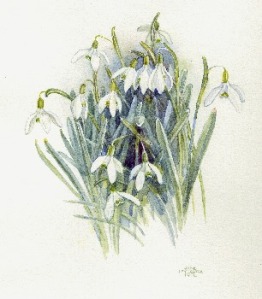
6. Snowdrop Galanthus Nivalis which is also part of the Daffodil family Amaryllidaceae is doubtfully native in damp woods and by streams, and certainly a garden escape on roadsides and waste ground. The flowers are solitary, their snowy white inner petals tipped green. For welcome assurance that the brighter days of spring are on their way, look no further than snowdrops. They are surprisingly varied in height, flower size, shape and even colouring. Given a moist soil they will multiply into drifts and provide plenty of plants. They flowers from January to March and are partial to shade.
Snowdrops and their bulbs are poisonous to humans and can cause nausea, diarrhoea and vomiting if eaten in large quantities. The bulb of the snowdrop can help to slow down alzheimer’s disease, poliomyelitis and neuralgia, if prepared properly. The traditional use for Snowdrops is a rub-on treatment for headaches, painkiller and poison antidote. A modern use for these spring blooms is Reminyl, one of the main type of drugs used to treat mild to moderate dementia, is derived from galantamine, a compound found in snowdrop bulbs.
To an Early Snowdrop by Paul Holmes
How amazing to see you
Ahead of your hour
Using your strength
To reveal a small flower.
Like a pure white pearl
Amid emerald blades
Your head peeps through
Winter’s harsh shades.
A courageous act
Pushing through frozen earth
To show me your beauty,
To reveal your true worth.
Stand tall and proud,
Delight me with your charm;
For the merest sight of you
Makes my heart calm.
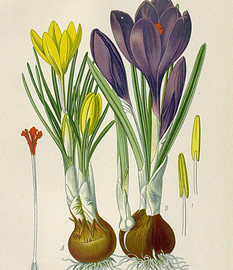
7. Crocus Crocus vernus (purple or white) Crocus flavus (yellow, long lasting) Crocus tommasinianus (a wide range of colours, mostly lilac and purple) and Crocus Angustifolius (cloth-of-gold crocus). The cup-shaped, solitary, salverform flower tapers off into a narrow tube. Their colors vary enormously, although lilac, mauve, yellow, and white are predominant. When it seems like winter will never lose its icy grip, the dainty goblet-shaped crocus pushes through the snow to put on a show of colorful revival. Many have strong perfumes that lure bees out of their hives when they bloom in February and March. Most Crocus Plants are poisonous and should never be ingested.
In the language of flowers, crocus means cheerfulness.
And all the woods are alive with the murmur and sound of Spring,
And the rose-bud breaks into pink on the climbing briar,
And the crocus-bed is a quivering moon of fire
Girdled round with the belt of an amethyst ring.
–Oscar Wilde
8. Cherry Blossom Prunus serrulata every year from February till April, these blossoms are in full bloom. The flower is comprised of three to five tiny flowers and blooms downwards. After the flowers fall, a bright red oval-shaped drupe fruit is formed. It changes to a red-black color when it matures and becomes edible.
Both the leaves and flowers of the Cherry Blossom are edible and have been used in culinary recipies in Japan for many years.
The blossoms are pickled in salt and umezu (plum vinegar), and used for coaxing out flavor in wagashi, (a traditional Japanese confectionery,) or anpan, (a Japanese sweet bun, most-commonly filled with red bean paste.)
Salt-pickled blossoms in hot water are called sakurayu, and drunk at festive events like weddings in place of green tea.
The leaves, mostly from the Ōshima cherry because of the softness, are also pickled in salted water and used for sakuramochi.
Since the leaves contain coumarin, which is toxic in large doses, it is not recommended to eat them in great quantities.
In Japan, cherry blossoms also symbolize clouds due to their nature of blooming en masse, besides being an enduring metaphor for the ephemeral (lasting a very short time) nature of life; the transience of the blossoms, the extreme beauty and quick death, has often been associated with mortality and for this reason, cherry blossoms are richly symbolic.
Cherry Blossoms of the Palace- Travis Morgan
The cherry blossom tree
sneezed on the wooden bench below,
covering it in pink petals,
accenting the snow.
Cherry Blossoms Adrift- Mary Fumento (1999)
Pink petals passing
Scents above so high
Painted porcelain perfection
Blossoms caress the sky
Swaying silent shroud
Suitors strolling by
Pink petals passing
Lover’s gentle sigh
Pastel hues falling
Slow fluttering grace
Pink petals passing
Lining streams in lace
Pink petals passing
Smoothest transit by
Soft essence floating
In most subtle lullaby
Inducing springtime slumber
Upon a satin shore
Sailing with the current
Pink petals pass before
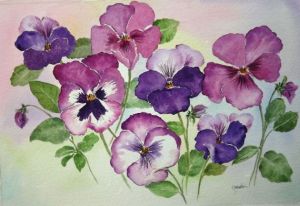
9. Pansy Viola Tricolor Subsp. Hortensis ‘Velour Purple and White’ (Velour Series) is a compact pansy, with yellow-eyed, light purple flowers with white markings, flowering in spring and summer. The name pansy is from the French word pensie, meaning thought or remembrance. The pansy is a delicate looking flower often with a “face”. The Pansies blooms are both fragrant and edible. Both the leaves and flowers of pansies and violas are high in vitamins A and C. The flowers impart a strong flavor and have been used to make syrup, flavored honey and salads. Both the leaves and flowers can be used as a garnish, such as on cold fruit or cream soups. The flowers are also useful as a dye.
Pansies-Unknown
Petals of velvet, colors so bright,
Smiling and nodding long into the night.
Round, joker faces that dance with the moon,
Lilting and tilting a flower song tune.
Warm summer sunbeams captured for all,
By round little flowers, so sweet and so small.
Bright pansy colors, a study in light,
Reflecting the moonbeams that dance in the night.
10. Dandelion Taraxacum Officinale is an abundant and very variable weed of bare and grassy places, flowers almost all seasons, but especially in spring. It’s leaves and leafless stems have milky juice. The flower heads are yellow to orange coloured, and are open in the daytime but closed at night. The heads are borne singly on a hollow stem that rises 10 cm or more above the leaves. A single plant may produce several flowering stems at a time. The flower heads mature into spherical seed heads called “blowballs” or “clocks” containing many single-seeded fruits called achenes. Each achene is attached to a fine hair, which enable wind-aided dispersal over long distances. Dandelion is a non toxic herb that is wonderful as a salad green and makes delightful wine. its medicinal uses are many, Rubbed on the skin the juice is antibacterial and kills staph, meningitis among others. The whitish sap that flows from the stalk will remove warts. Taken as a tea, dandelion is a potent detoxifying agent that allows potassium to remain in the body, it strengthens the kidneys and kidneys and urinary system. It has also been shown to help with chronic joint and skin complaints, gout, eczema, jaundice and acne. Another use is to put the leaves, and flowers of the plant in a brown paper bag with unripened fruit, it speeds the process.
The name Dandelion comes from the french for “Lion’s tooth” after the shape of the leaves.
Little Dandelion
Bright little Dandelion
Lights up the meads,
Swings on her slender foot,
Telleth her beads,
Lists to the robin’s note
Poured from above;
Wise little Dandelion
Asks not for love.
Cold lie the daisy banks
Clothed but in green,
Where, in the days agone,
Bright hues were seen.
Wild pinks are slumbering,
Violets delay;
True little Dandelion
Greeteth the May.
Brave little Dandelion!
Fast falls the snow,
Bending the daffodil’s
Haughty head low.
Under that fleecy tent,
Careless of cold,
Blithe little Dandelion
Counteth her gold.
Meek little Dandelion
Groweth more fair,
Till dies the amber dew
Out from her hair.
High rides the thirsty sun,
Fiercely and high;
Faint little Dandelion
Closeth her eye.
Pale little Dandelion,
In her white shroud,
Heareth the angel-breeze
Call from the cloud;
Tiny plumes fluttering
Make no delay;
Little winged Dandelion
Soareth away.
Helen Barron Bostwick

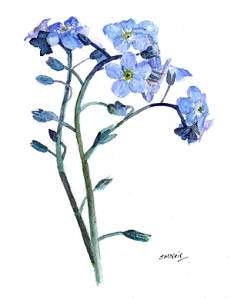
11. Forget-me-not Myosotis Arvensis has grey-blue flowers less than 6mm across, and is common on dry, bare, or disturbed ground, sandy places, and dunes. In a German legend, God named all the plants when a tiny unnamed one cried out, “Forget-me-not, O Lord!” God replied, “That shall be your name.” Another legend tells when the Creator thought he had finished giving the flowers their colours, he heard one whisper “Forget me not!” There was nothing left but a very small amount of blue, but the forget-me-not was delighted to wear such a light blue shade. Henry IV adopted the flower as his symbol during his exile in 1398, and retained the symbol upon his return to England the following year. In 15th-century Germany, it was supposed that the wearers of the flower would not be forgotten by their lovers. Legend has it that in medieval times, a knight and his lady were walking along the side of a river. He picked a posy of flowers, but because of the weight of his armour he fell into the river. As he was drowning he threw the posy to his loved one and shouted “forget me not”. It was often worn by ladies as a sign of faithfulness and enduring love.
Forget-me-not is a herb. The whole plant is used to make medicine. Despite safety concerns, people take forget-me-not for lung problems and nosebleeds.
Forget Me (Not?) -Unknown
Forgetful little flower
Only learned to follow
But never to follow through
With the little things
Like her dreams
He loves me, he loves me not
Was all she could think about
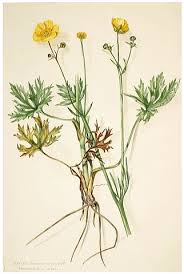
12.The Buttercup family Ranunculaceae are very varied in appearance and by no means all members resemble the buttercups proper, Ranunculus, with their shiny, bright, yellow, five-petaled flowers. Three species of buttercup grow commonly in grassy places:the tall Meadow Buttercup; Ranunculus Bulbosus are the most common in this area, and are responsible for making our meadows yellow in May and June. People dry the parts that grow above the ground and use them for medicine. Fresh preparations are very irritating and should not be used. Buttercup is used for arthritis, nerve pain, blisters, ongoing (chronic) skin problems, and bronchitis. Buttercups are usually considered not edible. Of the 2,252 species in the family and some 600 buttercups in the genus perhaps a dozen and a half squeak into the edible realm. Potential famine food. So, which part is toxic? The entire plant: Sap, flowers, seeds, and leaves but the greatest concentration is in the yellow flowers, next are the shoots which have one-sixth as much. However, dried the plant can be eaten by cows. Heat also destroys the toxin.
It was thought that the rich yellow of the buttercup made better butter from cows feeding in buttercup-rich meadows (we know this isn’t true). Beggars used to blister their skin purposefully with buttercup juice to arouse the sympathy of passersby. Fishermen of the 1800s poured buttercup tea on the ground to bring worms to the surface. Holding a tall buttercup flower against one’s neck on the night of a full moon, or simply smelling the flower, causes insanity, hence the folk name ‘crazyweed.
Buttercup
Let us take the time to look
Upon the lowly buttercup
Her beauty is there for all to see
She sits there very prettily
Full of golden glowing grace
A sunny smile upon her face
She feels not need to compete
With others who are more elite
She grows where others wouldn’t dare
Brightening a patch once bare.
13.Daisy
Posted in Uncategorized
|


